•  
Ig Nobel prize ceremony

Ig Nobel prize ceremony

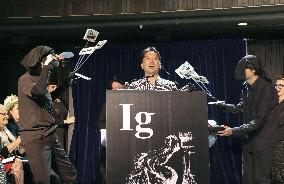
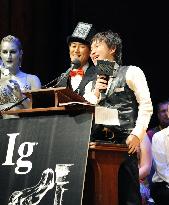
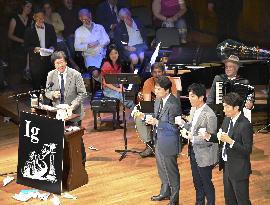
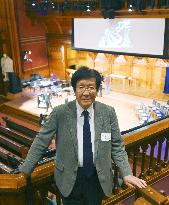
Tomoki Kojima (C), a researcher at the National Agriculture and Food Research Organization, wearing a zebra-patterned shirt, explains his team's findings at an Ig Nobel prize ceremony at Boston University in Boston on Sept. 18, 2025. The team won the Ig Nobel prize in biology for their experiment showing that painting zebra-like stripes on cattle significantly reduces the number of biting flies landing on them.

  •  
Ig Nobel prize ceremony

Ig Nobel prize ceremony

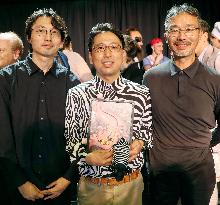
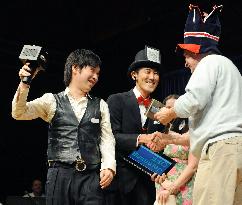
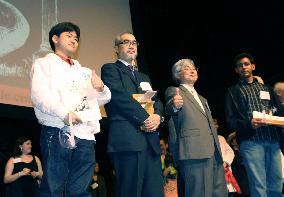
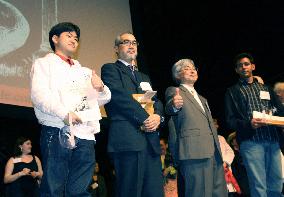
(From L) Kazato Oishi, an associate professor at Kyoto University, Tomoki Kojima, a researcher at the National Agriculture and Food Research Organization, and Sei Sato, section chief at the Aichi Livestock and Poultry Breeding Center, pose for photos in Boston on Sept. 18, 2025, after their team won the Ig Nobel prize in biology. Their experiment showing that painting zebra-like stripes on cattle significantly reduces the number of biting flies landing on them was recognized at a ceremony in Boston.

  •  
Ig Nobel prize ceremony

Ig Nobel prize ceremony

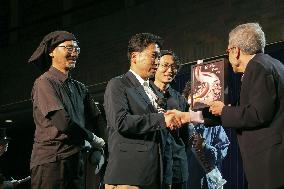
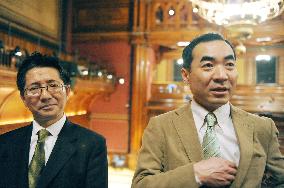
(From L) Sei Sato, section chief at the Aichi Livestock and Poultry Breeding Center, Tomoki Kojima, a researcher at the National Agriculture and Food Research Organization, and Kazato Oishi, an associate professor at Kyoto University, attend an Ig Nobel prize ceremony in Boston on Sept. 18, 2025. Their experiment showing that painting zebra-like stripes on cattle significantly reduces the number of biting flies landing on them was recognized at a ceremony in Boston.

  •  
Kirin to sell spoon to enhance salty taste

Kirin to sell spoon to enhance salty taste

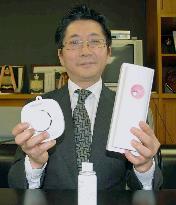
Photo taken on May 20, 2024, shows a spoon developed by Kirin Holdings Co. that uses a faint electrical current to enhance salty and umami flavors, with online sales of the product to start the same day priced at 19,800 yen ($125). Meiji University Professor Homei Miyashita, who jointly developed the technology, won the Ig Nobel Nutrition prize in 2023.

  •  
Ig Nobel winner makes commemorative speech on campus

Ig Nobel winner makes commemorative speech on campus

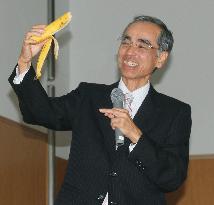
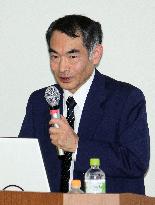
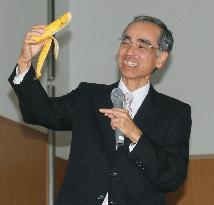
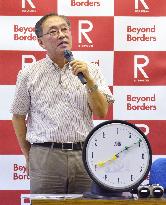
YOKOHAMA, Japan - Kiyoshi Mabuchi, professor of Japan's Kitasato University and winner of this year's Ig Nobel Prize for physics, speaks at the university's Sagamihara campus in Kanagawa Prefecture, southwest of Tokyo, on Nov. 1, 2014, about his work measuring the extent of friction created when someone steps on a banana skin.

  •  
Japan professor wins Ig Nobel for banana study

Japan professor wins Ig Nobel for banana study

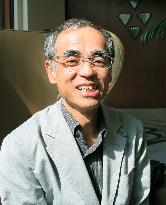
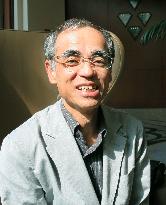
NEW YORK, United States - Kiyoshi Mabuchi, professor of Japan's Kitasato University, seen in this undated photo, was awarded the Ig Nobel Prize for physics in New York on Sept. 18, 2014, for his work measuring the friction created when someone steps on a banana skin.

  •  
Banana peel slickness study nets Japanese team Ig Nobel award

Banana peel slickness study nets Japanese team Ig Nobel award

CAMBRIDGE, United States - Kiyoshi Mabuchi (L front), a professor of Japan's Kitasato University, holds a banana speaking about the work by a group of researchers, including himself, measuring the friction that occurs when someone steps on a banana peel, which led to the winning of the spoof Ig Nobel Prize for physics in 2014, at Harvard University in Cambridge, Massachusetts, on Sept. 18, 2014.

  •  
Banana peel slickness study nets Japanese team Ig Nobel award

Banana peel slickness study nets Japanese team Ig Nobel award

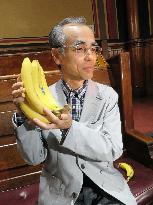
CAMBRIDGE, United States - Kiyoshi Mabuchi, a professor of Japan's Kitasato University, holds a bunch of bananas during an interview with Kyodo News at Harvard University in Cambridge, Massachusetts, on Sept. 18, 2014. The work by a group of researchers, including himself, measuring the friction that occurs when someone steps on a banana peel, led to the winning of the spoof Ig Nobel Prize for physics in 2014, which was awarded the same day at the university.

  •  
Ig Nobel award

Ig Nobel award

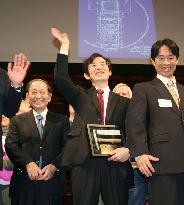
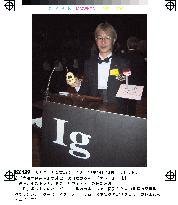
CAMBRIDGE, United States - Shinsuke Imai (C), a senior researcher at Japan's House Foods Corp., and Ishikawa Prefectural University President Hidehiko Kumagai (L) attend an award ceremony at Harvard University in Cambridge, Massachusetts, on Sept. 12, 2013. Their group won the spoof Ig Nobel chemistry prize for researching the possibility of a tear-free, yet flavorful, onion.

  •  
Ig Nobel award

Ig Nobel award

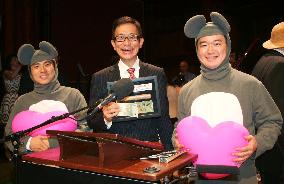
CAMBRIDGE, United States - Teikyo University School of Medicine Associate Professor Masanori Niimi (C) poses for photos with co-awardees during an award ceremony at Harvard University in Cambridge, Massachusetts, on Sept. 12, 2013. Their group won the spoof Ig Nobel medicine prize for studying how opera music affects mice heart transplants.

  •  
Ig Nobel prize

Ig Nobel prize

CAMBRIDGE, United States - Japanese researchers Kazutaka Kurihara (C) and Koji Tsukada (R) speak during an award ceremony at Harvard University in Cambridge, Massachusetts, on Sept. 20, 2012. They won the spoof Ig Nobel acoustic prize for developing the SpeechJammer, a device that confuses and stifles a person speaking by sending the speaker a delayed recording of their own voice.

  •  
Ig Nobel prize

Ig Nobel prize

CAMBRIDGE, United States - Japanese researchers Koji Tsukada (L) and Kazutaka Kurihara (C) receive the spoof Ig Nobel acoustic prize for developing the SpeechJammer, a device that confuses and stifles a person speaking by sending the speaker a delayed recording of their own voice, during an award ceremony at Harvard University in Cambridge, Massachusetts, on Sept. 20, 2012.

  •  
'Wasabi fire alarm' wins Ig Nobel prize

'Wasabi fire alarm' wins Ig Nobel prize

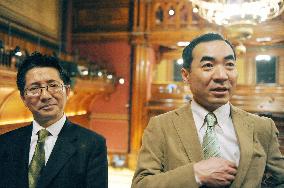
CAMBRIDGE, United States - Yukinobu Tajima (L), head of the Fragrance Marketing Association, and Makoto Imai, assistant professor of Shiga University of Medical Science, speak with reporters at Harvard University in Cambridge, Massachusetts on Sept. 29, 2011 shortly before attending the award ceremony there for the 2011 Ig Nobel prizes. Seven Japanese researchers including Tajima and Imai were awarded the prize in chemistry for inventing a fire alarm device which informs people with hearing impediments of a fire by emitting a pungent ''wasabi'' horseradish smell.

  •  
'Wasabi fire alarm' wins Ig Nobel prize

'Wasabi fire alarm' wins Ig Nobel prize

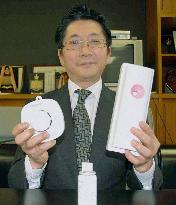
TOKYO, Japan - Photo shows Yukinobu Tajima, head of the Fragrance Marketing Association, in Takamatsu, Kagawa Prefecture, in April 2009 holding a fire alarm device that informs people with hearing impediments of a fire by emitting a pungent ''wasabi'' horseradish smell. Tajima, together with six other Japanese researchers, were awarded the 2011 Ig Nobel prize in chemistry at the award ceremony at Harvard University in Cambridge, Massachusetts, on September 29, 2011, for inventing the device.

  •  
Japanese among Ig Nobel winners

Japanese among Ig Nobel winners

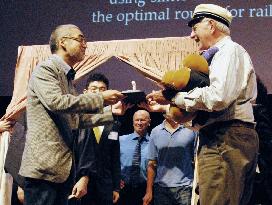
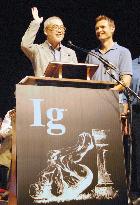
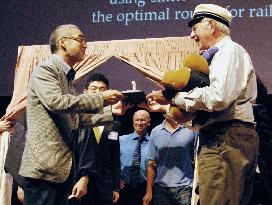
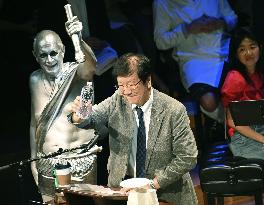
CAMBRIDGE, United States - Toshiyuki Nakagaki (C), professor at Future University Hakodate, jointly receives the Ig Nobel Prize at Harvard University's Sanders Theatre on Sept. 30, 2010, in Cambridge, Massachusetts. The professor, along with Atsushi Tero, researcher at the Japan Science and Technology Agency, and Ryo Kobayashi, professor at Hiroshima University, and two British scholars, won the prize for using slime molds to determine optimal routes for railroad tracks.

  •  
Japanese among Ig Nobel winners

Japanese among Ig Nobel winners

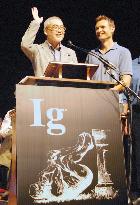
CAMBRIDGE, United States - Toshiyuki Nakagaki, professor at Future University Hakodate, waves from the podium after jointly receiving the Ig Nobel Prize at Harvard University's Sanders Theatre on Sept. 30, 2010, in Cambridge, Massachusetts. The professor, along with Atsushi Tero, researcher at the Japan Science and Technology Agency, and Ryo Kobayashi, professor at Hiroshima University, and two British scholars, won the prize for using slime molds for determining optimal routes for railroad tracks.

  •  
Japanese among Ig Nobel winners

Japanese among Ig Nobel winners

CAMBRIDGE, United States - Toshiyuki Nakagaki (L), professor at Future University Hakodate, jointly receives the Ig Nobel Prize at Harvard University's Sanders Theatre on Sept. 30, 2010, in Cambridge, Massachusetts. The professor, along with Atsushi Tero, researcher at the Japan Science and Technology Agency, and Ryo Kobayashi, professor at Hiroshima University, and two British scholars, won the prize for using slime molds to determine optimal routes for railroad tracks.

  •  
Taguchi wins Ig Nobel Prize for cutting waste using panda feces

Taguchi wins Ig Nobel Prize for cutting waste using panda feces

CAMBRIDGE, United States - Fumiaki Taguchi, professor emeritus at the graduate school of medical sciences in Kitasato University, makes a speech during the Ig Noble awards ceremony at Harvard University's historic Sanders Theater in Cambridge, Massachusetts, on Oct. 1, 2009. Taguchi is among this year's winners of the Ig Nobel Prize for developing a method to cut kitchen refuse using bacteria derived from giant panda feces.

  •  
Japanese win Ig Nobel Prize for for Cognitive Science Prize

Japanese win Ig Nobel Prize for for Cognitive Science Prize

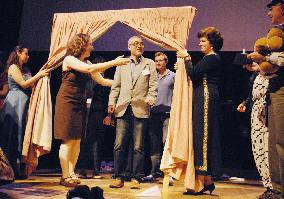
CAMBRIDGE, United States - Toshiyuki Nakagaki (2nd from L), associate professor at Hokkaido University, Ryo Kobayashi (2nd from R), professor at Hiroshima University, and Atsushi Tero (L), a researcher at the Japan Science and Technology Agency, pose after they were awarded the Ig Nobel Prize for Cognitive Science at Harvard University in Cambridge, Massachusetts, on Oct. 2. They discovered that a unicellular amoeboid organism can work out the shortest distance in a maze.

  •  
Dr. Nakamatsu wins Ig Nobel Prize for documenting meals

Dr. Nakamatsu wins Ig Nobel Prize for documenting meals

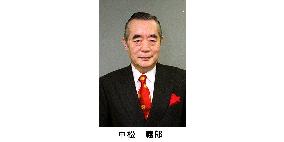
NEW YORK, United States - Yoshiro Nakamatsu (file photo), commonly known as Dr. Nakamatsu, won the Ig Nobel Prize in the nutrition science category on Oct. 6 for taking photos of all his meals over 35 years and analyzing the effects of food on brain activity, health condition and life duration. The prize ceremony was held at Harvard University in Boston as the award is sponsored by the science humor magazine Annals of Improbable Research linked with the university.

  •  
'Bow-Lingual' awarded 'Ig Nobel' peace prize

'Bow-Lingual' awarded 'Ig Nobel' peace prize

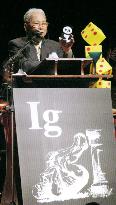
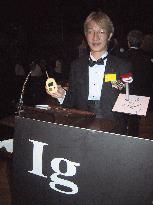
BOSTON, United States - Masahiko Kajita of Japanese toy maker Takara Co. holds up a dog-to-human-language translation device, dubbed ''Bow-Lingual,'' at a ceremony of the 12th annual ''Ig Nobel Prizes,'' a parody of the Nobel prizes, at Harvard University in Boston on Oct. 3. Takara's device was given the award for ''promoting peace and harmony between the species.''

  •  
Doctor who won Ig Nobel prize for kissing study gives inside story

Doctor who won Ig Nobel prize for kissing study gives inside story

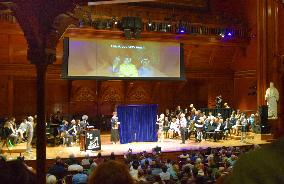
Hajime Kimata, who won the 2015 spoof Ig Nobel medicine prize, gives a speech in Osaka, western Japan, on Dec. 6, 2015, to reveal the inside story of his research. Kimata, who runs an allergy clinic in Neyagawa, Osaka Prefecture, confirmed that 30 minutes of kissing with a lover or spouse behind closed doors while listening to soft music can reduce allergic reactions among atopic and allergic patients. (Kyodo) ==Kyodo

  •  
Japanese doctor wins 2015 Ig Nobel medicine prize

Japanese doctor wins 2015 Ig Nobel medicine prize

A video message by Japanese doctor Hajime Kimata, a winner of the 2015 Ig Nobel medicine prize, is played during an award ceremony at Harvard University in Cambridge, Massachusetts, on Sept. 17, 2015. Kimata won the prize for his study "Kissing reduces allergic skin wheal responses and plasma neurotrophin levels." (Kyodo) ==Kyodo

  •  
Japanese doctor wins Ig Nobel award for kissing as allergy relief study

Japanese doctor wins Ig Nobel award for kissing as allergy relief study

A couple kiss during the spoof Ig Nobel medicine prize ceremony at Harvard University in Cambridge, Massachusetts, on Sept. 17, 2015. Japanese scientist Hajime Kimata received the prize jointly with three Slovakian scientists for a study that revealed kissing could reduce allergic reactions in humans. (Kyodo) ==Kyodo

  •  
Dr. Nakamatsu wins Ig Nobel Prize for documenting meals

Dr. Nakamatsu wins Ig Nobel Prize for documenting meals

NEW YORK, United States - Yoshiro Nakamatsu (file photo), commonly known as Dr. Nakamatsu, won the Ig Nobel Prize in the nutrition science category on Oct. 6 for taking photos of all his meals over 35 years and analyzing the effects of food on brain activity, health condition and life duration. The prize ceremony was held at Harvard University in Boston as the award is sponsored by the science humor magazine Annals of Improbable Research linked with the university. (Kyodo)

  •  
Japanese win Ig Nobel Prize for for Cognitive Science Prize

Japanese win Ig Nobel Prize for for Cognitive Science Prize

CAMBRIDGE, United States - Toshiyuki Nakagaki (2nd from L), associate professor at Hokkaido University, Ryo Kobayashi (2nd from R), professor at Hiroshima University, and Atsushi Tero (L), a researcher at the Japan Science and Technology Agency, pose after they were awarded the Ig Nobel Prize for Cognitive Science at Harvard University in Cambridge, Massachusetts, on Oct. 2. They discovered that a unicellular amoeboid organism can work out the shortest distance in a maze. (Kyodo)

  •  
Taguchi wins Ig Nobel Prize for cutting waste using panda feces

Taguchi wins Ig Nobel Prize for cutting waste using panda feces

CAMBRIDGE, United States - Fumiaki Taguchi, professor emeritus at the graduate school of medical sciences in Kitasato University, makes a speech during the Ig Noble awards ceremony at Harvard University's historic Sanders Theater in Cambridge, Massachusetts, on Oct. 1, 2009. Taguchi is among this year's winners of the Ig Nobel Prize for developing a method to cut kitchen refuse using bacteria derived from giant panda feces. (Kyodo)

  •  
Japanese among Ig Nobel winners

Japanese among Ig Nobel winners

CAMBRIDGE, United States - Toshiyuki Nakagaki (C), professor at Future University Hakodate, jointly receives the Ig Nobel Prize at Harvard University's Sanders Theatre on Sept. 30, 2010, in Cambridge, Massachusetts. The professor, along with Atsushi Tero, researcher at the Japan Science and Technology Agency, and Ryo Kobayashi, professor at Hiroshima University, and two British scholars, won the prize for using slime molds to determine optimal routes for railroad tracks. (Kyodo)

  •  
Japanese among Ig Nobel winners

Japanese among Ig Nobel winners

CAMBRIDGE, United States - Toshiyuki Nakagaki, professor at Future University Hakodate, waves from the podium after jointly receiving the Ig Nobel Prize at Harvard University's Sanders Theatre on Sept. 30, 2010, in Cambridge, Massachusetts. The professor, along with Atsushi Tero, researcher at the Japan Science and Technology Agency, and Ryo Kobayashi, professor at Hiroshima University, and two British scholars, won the prize for using slime molds for determining optimal routes for railroad tracks. (Kyodo)

  •  
Japanese among Ig Nobel winners

Japanese among Ig Nobel winners

CAMBRIDGE, United States - Toshiyuki Nakagaki (L), professor at Future University Hakodate, jointly receives the Ig Nobel Prize at Harvard University's Sanders Theatre on Sept. 30, 2010, in Cambridge, Massachusetts. The professor, along with Atsushi Tero, researcher at the Japan Science and Technology Agency, and Ryo Kobayashi, professor at Hiroshima University, and two British scholars, won the prize for using slime molds to determine optimal routes for railroad tracks. (Kyodo)

  •  
'Wasabi fire alarm' wins Ig Nobel prize

'Wasabi fire alarm' wins Ig Nobel prize

CAMBRIDGE, United States - Yukinobu Tajima (L), head of the Fragrance Marketing Association, and Makoto Imai, assistant professor of Shiga University of Medical Science, speak with reporters at Harvard University in Cambridge, Massachusetts on Sept. 29, 2011 shortly before attending the award ceremony there for the 2011 Ig Nobel prizes. Seven Japanese researchers including Tajima and Imai were awarded the prize in chemistry for inventing a fire alarm device which informs people with hearing impediments of a fire by emitting a pungent ''wasabi'' horseradish smell. (Kyodo)

  •  
'Wasabi fire alarm' wins Ig Nobel prize

'Wasabi fire alarm' wins Ig Nobel prize

TOKYO, Japan - Photo shows Yukinobu Tajima, head of the Fragrance Marketing Association, in Takamatsu, Kagawa Prefecture, in April 2009 holding a fire alarm device that informs people with hearing impediments of a fire by emitting a pungent ''wasabi'' horseradish smell. Tajima, together with six other Japanese researchers, were awarded the 2011 Ig Nobel prize in chemistry at the award ceremony at Harvard University in Cambridge, Massachusetts, on September 29, 2011, for inventing the device. (Kyodo)

  •  
Ig Nobel winner makes commemorative speech on campus

Ig Nobel winner makes commemorative speech on campus

YOKOHAMA, Japan - Kiyoshi Mabuchi, professor of Japan's Kitasato University and winner of this year's Ig Nobel Prize for physics, speaks at the university's Sagamihara campus in Kanagawa Prefecture, southwest of Tokyo, on Nov. 1, 2014, about his work measuring the extent of friction created when someone steps on a banana skin. (Kyodo)

  •  
Japan professor wins Ig Nobel for banana study

Japan professor wins Ig Nobel for banana study

NEW YORK, United States - Kiyoshi Mabuchi, professor of Japan's Kitasato University, seen in this undated photo, was awarded the Ig Nobel Prize for physics in New York on Sept. 18, 2014, for his work measuring the friction created when someone steps on a banana skin. (Kyodo)

  •  
Banana peel slickness study nets Japanese team Ig Nobel award

Banana peel slickness study nets Japanese team Ig Nobel award

CAMBRIDGE, United States - Kiyoshi Mabuchi (L front), a professor of Japan's Kitasato University, holds a banana speaking about the work by a group of researchers, including himself, measuring the friction that occurs when someone steps on a banana peel, which led to the winning of the spoof Ig Nobel Prize for physics in 2014, at Harvard University in Cambridge, Massachusetts, on Sept. 18, 2014. (Kyodo)

  •  
Ig Nobel's Acoustics prize winner

Ig Nobel's Acoustics prize winner

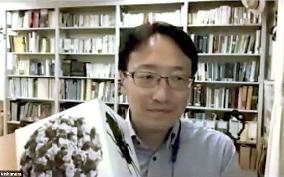
Screenshot image shows Japanese scientist Takeshi Nishimura, an associate professor at Kyoto University, as he appears on the Ig Nobel Prize Ceremony held online on Sept. 17, 2020. An international research team, including Nishimura, won the Acoustics prize of the spoof awards for their study that discovered an alligator's pitch rises after it inhales helium-enriched air.

  •  
Japan team wins Ig Nobel award for measuring children's saliva

Japan team wins Ig Nobel award for measuring children's saliva

Shigeru Watanabe (L), a professor of pediatric dentistry at the School of Health Sciences at Meikai University in Japan, is pictured during a ceremony at Harvard University in Cambridge, Massachusetts, on Sept. 12, 2019, after a team of five Japanese led by him won the spoof Ig Nobel chemistry prize for their study estimating the daily saliva volume produced by a five-year-old child. (Kyodo) ==Kyodo

  •  
Japan team wins Ig Nobel award for measuring children's saliva

Japan team wins Ig Nobel award for measuring children's saliva

Shigeru Watanabe, a professor of pediatric dentistry at the School of Health Sciences at Meikai University in Japan, is pictured during a ceremony at Harvard University in Cambridge, Massachusetts, on Sept. 12, 2019, after a team of five Japanese led by him won the spoof Ig Nobel chemistry prize for their study estimating the daily saliva volume produced by a five-year-old child. (Kyodo) ==Kyodo

  •  
Japan team wins Ig Nobel award for measuring children's saliva

Japan team wins Ig Nobel award for measuring children's saliva

Shigeru Watanabe, a professor of pediatric dentistry at the School of Health Sciences at Meikai University in Japan, poses at Harvard University in Cambridge, Massachusetts, on Sept. 12, 2019, after a team of five Japanese led by him won the spoof Ig Nobel chemistry prize for their study estimating the daily saliva volume produced by a five-year-old child. (Kyodo) ==Kyodo

  •  
Japanese, others win Ig Nobel award for discovering unique insects

Japanese, others win Ig Nobel award for discovering unique insects

The award ceremony for the Ig Nobel Prize is held at Harvard University in Cambridge, Massachusetts, on Sept. 14, 2017. A group of four scientists, including two from Japan, won the biology prize for their discovery of insects with genitalia that reverse traditional sex roles. (Kyodo) ==Kyodo

  •  
Ig Nobel award winner attends debrief session

Ig Nobel award winner attends debrief session

The spoof Ig Nobel perception prize winner Atsuki Higashiyama (C), professor at Japan's Ritsumeikan University, demonstrates his award-winning achievement together with students at a debrief session in the city of Kyoto on Sept. 29, 2016. Higashiyama was given the award for determining that objects look smaller when viewed from between one's legs. (Kyodo) ==Kyodo

  •  
Ig Nobel award winner attends debrief session

Ig Nobel award winner attends debrief session

The spoof Ig Nobel perception prize winner Atsuki Higashiyama, professor at Japan's Ritsumeikan University, attends a debrief session in the city of Kyoto on Sept. 29, 2016. Higashiyama was given the award for determining that objects look smaller when viewed from between one's legs. (Kyodo) ==Kyodo

  •  
'Bow-Lingual' awarded 'Ig Nobel' peace prize

'Bow-Lingual' awarded 'Ig Nobel' peace prize

BOSTON, United States - Masahiko Kajita of Japanese toy maker Takara Co. holds up a dog-to-human-language translation device, dubbed ''Bow-Lingual,'' at a ceremony of the 12th annual ''Ig Nobel Prizes,'' a parody of the Nobel prizes, at Harvard University in Boston on Oct. 3. Takara's device was given the award for ''promoting peace and harmony between the species.'' (Kyodo)

  • Main
  • Top
  • Editorial
  • Creative
  • About Us
  • About ILG
  • Terms of use
  • Company
  • BEHIND
  • Price List
  • Single Plan
  • Monthly Plan
  • Services
  • Shooting
  • Rights Clearance
  • Support
  • FAQ
  • How To Buy
  • Contact Us
  • Become a Partner

© KYODO NEWS IMAGES INC

All Rights Reserved.

  • Editorial
  • Olympics
  • News
  • Sports
  • Japan
  • Tech
  • Royal
  • Disaster
  • NorthKorea
  • Old Japan
  • SNS
  • Creative
  • Food
  • Japan
  • Landscape
  • Animal
  • Popular
  • #Ukraine
  • #China
  • #coronavirus
  • #N. Korea
  • #Thailand
  • #Russia
  • #Ukraine
  • #China
  • #coronavirus
  • #N. Korea
  • #Thailand
  • #Russia
  • Food
  • Japan
  • Landscape
  • Animal
  • Olympics
  • News
  • Sports
  • Japan
  • Tech
  • Royal
  • Disaster
  • NorthKorea
  • Old Japan
  • SNS